JAILED FOR MEMES
The persecution of Douglass Mackey ignores artistic license

The United States Congress passed the first American copyright law in 1790. As we grow as a nation, so do our artistic and media capabilities. According to the U.S. Copyright Office:
Works are original when they are independently created by a human author and have a minimal degree of creativity. Independent creation simply means that you create it yourself, without copying. The Supreme Court has said that, to be creative, a work must have a “spark” and “modicum” of creativity.
In the autumn of 2016,
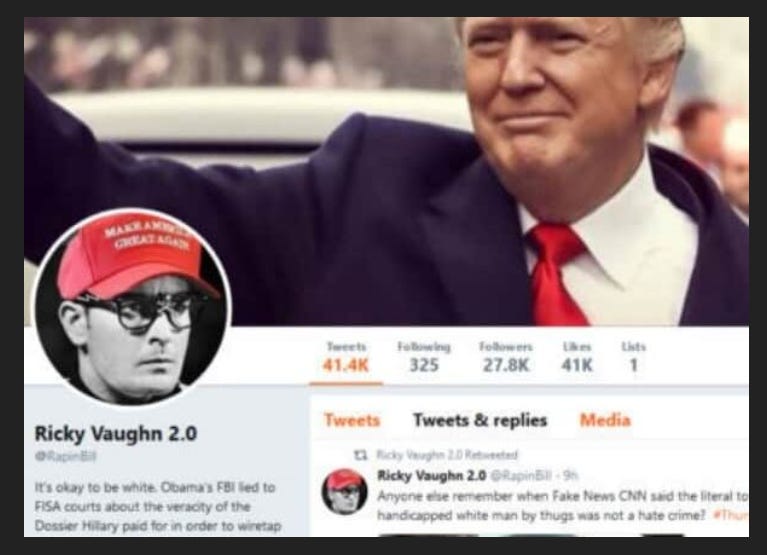
Doug Mackey
tweeted an image of a woman seated at a conference room, typing on her cellphone. This image included Spanish, and mimicked a font used by the Clinton campaign in their ads, a font the Clinton campaign neither copyrighted nor owns. The meme also included a copy of the Clinton campaign's logo and the "ImWithHer" hashtag. Such parody was found to run afoul of voting rights in the Eastern District of New York. But does it? What happened to artistic license and the resultant copyright? What happened to Fair Use?
Per 17 U.S.C. §107:
the fair use of a copyrighted work, including such use by reproduction in copies or phonorecords or by any other means specified by that section, for purposes such as criticism, comment, news reporting, teaching (including multiple copies for classroom use), scholarship, or research, is not an infringement of copyright.
The legal doctrine of Fair Use actually permits artistic license. One could argue
was upholding an American tradition of creativity and art by spreading political memes. Moreover, parody is an explicitly protected genre of Fair Use.
As explained by the Copyright Alliance:
While both parody and satire incorporate criticism and commentary, only parody may be considered fair use. The Supreme Court explained in Campbell v. Acuff-Rose Music, Inc., that “[p]arody needs to mimic an original to make its point, and so has some claim to use the creation of its victim’s (or collective victims’) imagination, whereas satire can stand on its own two feet and so requires justification for the very act of borrowing.”
Mackey, as Twitter account Ricky Vaughn, mimicked the original Clinton ads to make a point. Denying creators the ability to rely on existing material is to deny parody entirely, running afoul of U.S. copyright law.
I’m With Her appears on dozens of federally registered copyrights. In 2004, it was the name of a film guide on how to date celebrities (see copyright registration #PA0001622020). The use of this phrase by Mackey was considered definitive by his prosecutors, that he meant to sway voters one way or another. After the three-week trial, Mackey was sentenced to seven months in jail. But “I’m With Her” is literally just a phrase, and a phrase used in film, books and even musicals according to the U.S. Copyright register.